Building Better Mental Health Apps with the Ai Mental Health App Mobile UI KIT
The digital landscape for mental wellness is expanding rapidly, yet many developers and entrepreneurs struggle to translate compassionate concepts into functional, user-friendly interfaces. Creating an application that handles sensitive topics like anxiety, depression, or stress requires more than just coding; it demands a design that feels safe, intuitive, and trustworthy. This is where the Ai Mental Health App Mobile UI KIT becomes an essential tool for creators at any stage of their journey. By offering a comprehensive suite of pre-designed screens and elements, this kit allows you to bypass the initial paralysis of a blank canvas and focus on what truly matters: the user experience.
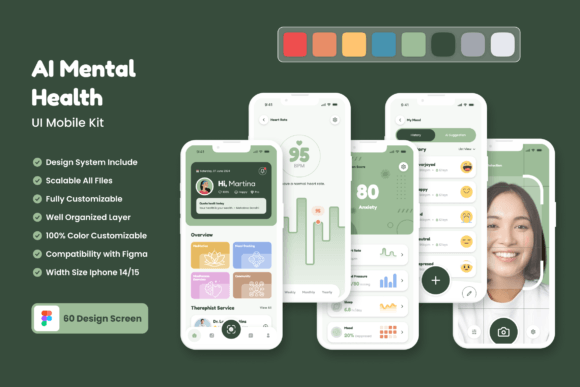
Many beginners make the mistake of assuming that starting from scratch is the only way to ensure uniqueness. While originality is valuable, reinventing every button, navigation bar, and input field is often a waste of time and resources. The Ai Mental Health App Mobile UI KIT provides 20 high-quality templates specifically tailored for mobile applications in the health sector. These are not rigid structures but flexible foundations. You can customize every screen by adding or subtracting elements to fit your specific vision. Whether you are using Adobe Photoshop, InDesign, Sketch, or Adobe XD, the fully editable nature of these files ensures that your final product reflects your brand identity without compromising on professional quality.
Avoiding Common Pitfalls in UI Selection
When evaluating design assets, one of the most frequent errors is prioritizing aesthetics over usability. A beautiful interface that confuses the user defeats the purpose of a mental health app, which must be calming and accessible. Some designers download kits that look stunning in preview images but lack the necessary layer organization or scalability required for real-world development. The Ai Mental Health App Mobile UI KIT addresses this by providing 100 scalable vector layers and symbol objects. This distinction is critical. Raster-based designs can become pixelated when resized for different screen densities, leading to a cheap appearance that undermines user trust.
Another common misunderstanding involves the scope of customization. Many creators fear that using a template will result in a generic app that looks identical to dozens of others. This concern is valid if the kit is poorly constructed, but it is easily avoidable with the right tools. With 80 distinct UI elements and free icon vectors included, you have ample material to create a unique visual language. The ability to change color styles easily means you can align the design with your brand's psychological color theory—perhaps using soothing blues and greens rather than aggressive reds—without needing advanced graphic design skills.
The Importance of Pixel-Perfect Precision
In the mobile space, precision is non-negotiable. Users interact with apps on devices ranging from compact smartphones to large tablets. If your buttons are slightly misaligned or your text is too small to read comfortably, users will abandon the app quickly. The Ai Mental Health App Mobile UI KIT boasts 20 pixel-perfect screen designs. This level of detail ensures that every element snaps correctly into place during the development phase. Ignoring this aspect can lead to significant rework later, inflating costs and delaying your launch. By starting with a foundation that respects grid systems and spacing rules, you save hours of debugging and alignment adjustments.
It is also crucial to understand the limitations of preview images. A note often overlooked by buyers is that all images used for marketing previews are for demonstration purposes only and are not included in the actual download files. This is standard industry practice to protect copyright, but it can lead to confusion if not anticipated. Do not expect to find stock photos of people or backgrounds in the final package. Instead, the kit focuses on the structural components—the layouts, icons, and typography—that form the skeleton of your app. You should plan to source your own imagery or use royalty-free alternatives that match your content strategy.
Maximizing Efficiency with Scalable Vectors
Efficiency in design directly correlates to the speed of your development cycle. When you work with 100 scalable vectors, you gain the freedom to resize graphics without losing clarity. This is particularly important for mental health apps, which often require clear, legible text and simple, recognizable icons to reduce cognitive load on the user. If you choose a kit that relies heavily on fixed-size raster images, you may find yourself struggling to adapt the design for various device resolutions. The vector-based approach of the Ai Mental Health App Mobile UI KIT eliminates this friction, allowing for seamless adaptation across iOS and Android platforms.
Furthermore, the inclusion of symbol objects in the kit streamlines the workflow for teams. Symbols allow you to update a single element, such as a navigation icon or a header style, and have that change propagate across all 20 screens instantly. Without this feature, updating a global element would require manual editing of every individual screen, a tedious process prone to human error. For freelancers and small business owners managing tight deadlines, this efficiency is a game-changer. It allows you to iterate quickly based on feedback without rebuilding the entire interface.
Evaluating Compatibility Before You Buy
Before committing to any design asset, always verify compatibility with your existing software stack. The Ai Mental Health App Mobile UI KIT is available for Adobe XD, Adobe Photoshop, Sketch, and InDesign. However, if your team primarily uses Figma or another tool not listed, importing these files might require conversion steps that could break layers or distort elements. Ensure that the file formats provided align with your current workflow to avoid unnecessary technical hurdles. Checking the file structure before purchase is a simple step that can prevent significant frustration down the line.
Additionally, consider the font licensing. The kit includes free fonts, which is a significant advantage for budget-conscious projects. Using unlicensed commercial fonts can lead to legal issues once your app goes live. By utilizing the included free typography, you ensure that your project remains compliant and cost-effective. Always review the documentation accompanying the kit to confirm the licensing terms for both the fonts and the UI elements themselves.
Strategic Customization for Better Results
The true power of the Ai Mental Health App Mobile UI KIT lies in its flexibility. It is designed to be a starting point, not a final destination. To achieve the best results, treat the templates as a framework upon which you build your unique value proposition. For example, if your app focuses on AI-driven chat therapy, you might prioritize customizing the chat interface screens while keeping the onboarding flow standard. Conversely, if your app is meditation-focused, you might spend more time refining the audio player controls and timer visuals.
Do not feel constrained by the initial layout. The fully layered nature of the files invites experimentation. You can rearrange elements, change hierarchies, and introduce new interactions that better serve your target audience. Remember that the goal is to create an app that resonates emotionally with users seeking help. A well-customized interface can guide users through difficult moments with clarity and calm, turning a standard template into a supportive digital companion.
Ultimately, choosing the right design toolkit is about balancing speed, quality, and adaptability. The Ai Mental Health App Mobile UI KIT offers a robust solution for those who want to launch a professional mobile application without getting bogged down in the minutiae of basic design tasks. By avoiding common pitfalls like ignoring scalability or underestimating the need for customization, you can leverage these 20 templates to build a product that is both visually appealing and functionally superior. Start with a solid foundation, customize with intention, and focus on delivering a meaningful experience for your users.